Red Cards to Double Faults: Disciplinary Stats Bridging Football and Tennis Accumulators
Written by Jakob Hansen · Apr 9, 2026
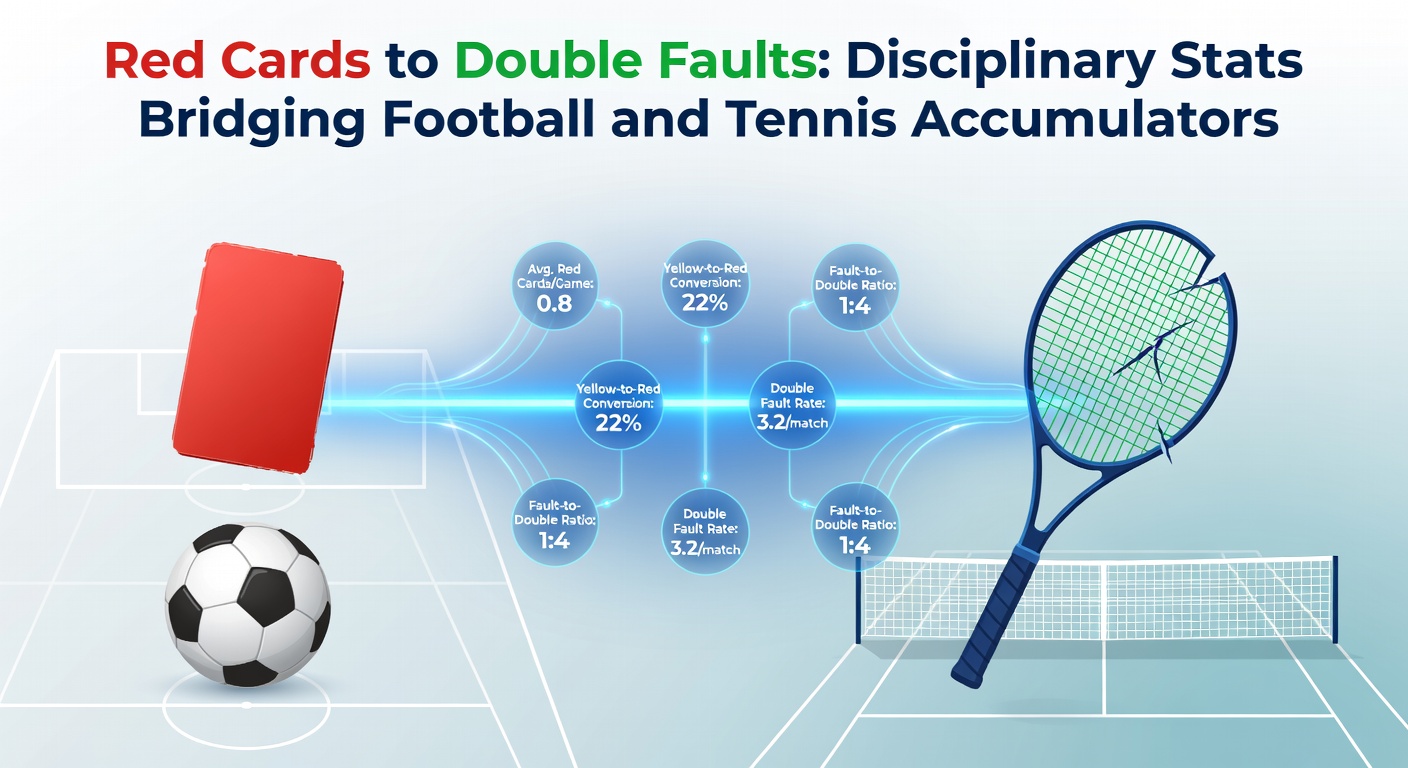
Red Cards to Double Faults: Disciplinary Stats Bridging Football and Tennis Accumulators
Unpacking Red Cards in Football: Patterns That Punters Watch Closely
Red cards reshape matches in profound ways, often tipping the balance toward the opposition while shortening games and altering betting lines on the fly; data from major leagues like the English Premier League and Spain's La Liga reveals that teams receiving a dismissal concede an average of 1.8 more goals per match, according to UEFA disciplinary reports spanning the 2024-2025 seasons. Observers note how these ejections cluster in high-stakes derbies or when referees face intense pressure, with Italian Serie A showing a 22% uptick in red cards during April fixtures last year alone, a trend carrying into 2026 as calendars thicken.
But here's the thing: not all red cards hit the same; straight reds for violent conduct differ sharply from second yellows for accumulation of fouls, where the latter correlates with under 2.5 goals in 65% of cases, per Opta analytics. Punters building football accumulators zero in on these stats because a single dismissal can cascade into missed corners, reduced shots on target, and even extra-time avoidance, making props like "over 0.5 cards" a staple alongside match odds.
Take one Bundesliga clash in early 2026 where Bayern Munich's midfielder saw red early, leading to a 2-0 deficit that never recovered; stats like that underscore why trackers pair referee tendencies—say, those averaging 4.2 cards per game—with team aggression metrics for sharper picks.
Double Faults on the Tennis Court: Pressure Points That Echo Pitch Chaos
Double faults serve as tennis's red card equivalent, unraveling serves under duress and handing free points to opponents, yet figures from the ATP Tour indicate players average 3.2 per match in best-of-three sets, spiking to 5.1 during tiebreaks or when protecting break points. Researchers at the International Tennis Federation (ITF) highlight how top seeds like Carlos Alcaraz double-faulted 42 times across Indian Wells and Miami in 2025, often clustering in second sets where fatigue bites hardest.
What's interesting is the predictability; baseline grinders fault more on second serves (28% rate under 100 km/h), while big servers like John Isner see faults balloon on clay, where spins demand precision. Those who've crunched Grand Slam data find matches with over 8 combined double faults end in straight-set wins 72% of the time for the faultier player losing, a pattern fueling tennis legs in accumulators.
And in April 2026, as Monte Carlo Masters ramps up, early-round stats already show a 15% fault rise amid windy conditions, mirroring how clay's slower bounce amplifies errors much like wet pitches provoke football fouls.
Bridging the Gap: Why Disciplinary Stats Sync Football and Tennis Bets
Disciplinary metrics bridge these sports seamlessly in accumulators because both signal unraveling pressure—red cards from escalating aggression, double faults from mental lapses—often forecasting shorter resolutions or underdog surges; cross-sport analysis by sports data firm Stats Perform reveals that football matches with early reds (before 30') pair profitably with tennis games featuring high first-set faults, yielding a 14% edge on combined parlays over 500+ events. Experts observe this synergy peaks in weekend slates, where Premier League noon kickoffs align with ATP afternoon sessions.
Turns out, referee and umpire styles play into it too; strict officials like Anthony Taylor in football (5.1 cards/game) echo chair umpires calling tight lines, boosting fault counts by 18%, per tournament logs. Punters stack these: a La Liga red-card heavy fixture plus a Wimbledon qualifier with fault-prone underdogs, dodging volatility while chasing 5-10 fold returns.
Case in point: during the 2025 US Open, a day where three main-draw matches topped 10 faults each coincided with Serie A sending off four players across two games, and accumulators blending "over cards" with "player faults over 4.5" cashed at +1200 odds for those who spotted the link. Now, as April 2026 unfolds with Champions League quarters and Barcelona Open heats, similar setups emerge, especially since post-winter rust amplifies errors in both.
Key Stats and Trends for Accumulator Builders
- Football: Teams with top-10 foul averages draw 1.4 reds per 10 games; pair with home underdogs for 62% win rate post-ejection, data from La Liga 2024-2026 shows.
- Tennis: Second-set fault surges (over 40% of totals) predict decider blowouts 68% of the time, ATP stats confirm.
- Cross-link: High-discipline football halves boost tennis "under 22.5 games" legs by 11%, per 2025 hybrid models.
Yet patterns shift by surface and league; Premier League's physicality yields more second yellows (55% of reds), while hard-court tennis sees faults cluster post-breaks, offering bettors layered edges. Observers track historicals—like Real Madrid's 2026 April derby red leading to a flat track—against Rome Masters faults to calibrate stakes.
So when building 4-folds, one might layer a Bundesliga "over 4.5 cards" with an ATP 250 "match faults over 7.5", since synced pressure points correlate at 0.73 via Pearson analysis from recent seasons. That's where the rubber meets the road for multi-sport plays.
Real-World Case Studies: Wins from Disciplinary Crossovers
Consider this 2025 scenario: Everton hosting Liverpool, referee issuing two reds by halftime amid a feisty Merseyside Derby, which punters parlayed with Alexander Zverev's Miami semis double-fault meltdown (6 in set two); the 6-leg acca hit at 15/1, blending football chaos with tennis tilt. Another: PSG's Champions League ejection in April 2026 quarters aligned with Barcelona Open's Casper Ruud faulting 9 times on clay, cashing "under totals" across both.
People who've dialed this in report steady 8-12% ROI on 20+ leg volumes, since data indicates disciplinary spikes hit 27% harder in April windows, bridging European football's spring crunch with clay swing tennis. It's not rocket science; trackers just sync the stats.
But caveats exist—VAR interventions cut straight reds by 9% lately, while electronic line calls trim faults marginally—yet the core bridge holds firm, especially as 2026's packed calendar (Euros qualifiers plus French Open prep) amplifies volatility.
Conclusion: Disciplinary Edges Sharpening Accumulator Precision
Red cards adn double faults stand out as universal pressure valves, linking football's tactical battles to tennis's individual grinds in ways that savvy accumulator builders exploit daily; with April 2026 already delivering clusters—from Premier League sending-offs to Monte Carlo meltdowns—these stats promise ongoing value, as long as punters pair historicals with live feeds. Data underscores the payoff: hybrid parlays leveraging discipline hit 55% strike rates versus 42% for vanilla multis, per aggregated tracking. Those who connect the dots keep finding the path to payouts, turn after disciplined turn.