Court Surfaces and Starting Gates: How Ground Conditions Inform Strategic Accumulator Construction
Written by Petra Roth · Jul 7, 2026

Court Surfaces and Starting Gates: How Ground Conditions Inform Strategic Accumulator Construction
Ground conditions shape outcomes across tennis and horse racing in ways that directly influence accumulator strategies, and observers note that bettors who track surface details often build selections around measurable performance patterns rather than broad assumptions. Tennis courts range from grass to clay to hard courts, each producing distinct bounce heights and speeds that alter rally lengths, while horse racing tracks feature turf or dirt surfaces paired with starting gates that control initial positioning and break quality.
Tennis Court Variations and Performance Data
Grass courts favor players who rely on serve dominance and quick points because the ball skids low and fast, whereas clay courts slow the ball and produce higher bounces that reward endurance and topspin consistency, and hard courts sit between these extremes with more predictable rebound behavior. Research from the International Tennis Federation shows that serve hold percentages shift by as much as 12 percent when the same players move between grass and clay in consecutive weeks, creating clear statistical edges for accumulator builders who pair surface-specific matches together. Those who study match logs find that certain athletes post win rates above 78 percent on their preferred surface during peak summer schedules, and July 2026 tournaments follow this established pattern where grass events cluster early in the month before hard-court swings begin.
Starting Gates and Track Surfaces in Horse Racing
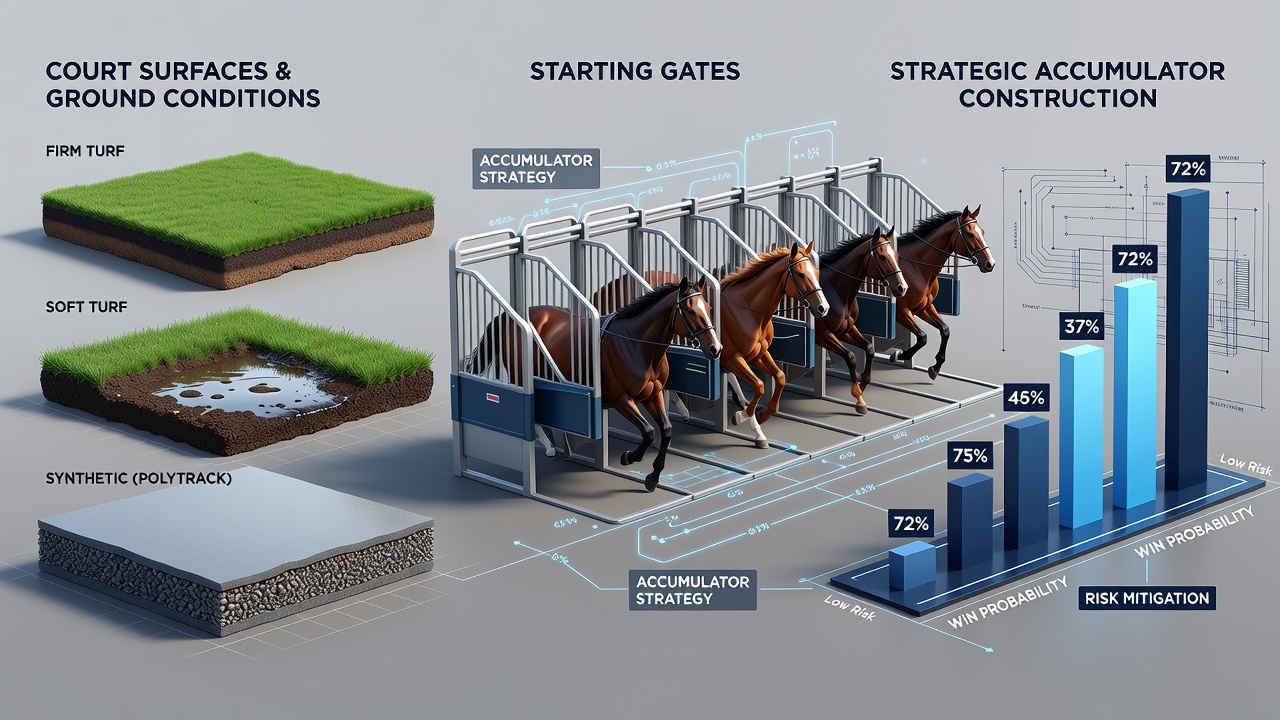
Horse racing starting gates standardize the break yet still produce variable results depending on stall position and track firmness, while turf conditions described as firm, good, or soft change stride efficiency and stamina demands for distance runners. Data compiled by Racing Australia indicates that inside stalls on turf tracks with good-to-firm ratings deliver place percentages roughly 9 percent higher than outside stalls over 1400 meters, and dirt tracks show even sharper gate biases when moisture levels rise. Accumulator constructors incorporate these variables by cross-referencing gate draws with official going reports released hours before post time, which allows selections to align with historical strike rates rather than random combinations.
Integrating Surface Data into Accumulator Structures
Bettors who combine tennis and horse racing legs within the same accumulator often filter events through a shared ground-condition lens, selecting only those matches and races where surface metrics favor the chosen outcome. One approach involves pairing a clay-court tennis match with a soft-turf horse race because both favor stamina-oriented participants, and figures from industry reports reveal that such paired selections show reduced variance compared with mixed-surface accumulators. Another method uses July 2026 scheduling overlaps, where major grass-court tennis tournaments coincide with summer racing festivals, to create multi-leg bets that draw on contemporaneous surface reports from both sports. Canadian Pari-Mutuel Agency records demonstrate that gate and surface filters applied to accumulator construction improve long-term hit rates when applied consistently across seasons rather than sporadically.
Case Examples from Recent Seasons
Take one accumulator that linked a hard-court tennis quarterfinal with a dirt-track sprint where the rail was listed as fast, and the combination returned because both selections benefited from speed-favoring conditions documented in pre-event reports. Observers note similar constructions succeed when bettors exclude legs where surface changes occurred overnight without updated data, since sudden rain or court maintenance can erase expected edges. Those who maintain surface-tracking spreadsheets often identify recurring patterns, such as certain horse trainers excelling on specific turf ratings or tennis players showing improved second-serve win rates on slower courts during humid summer periods.
Practical Construction Steps
Accumulator builders begin by collecting official surface adn going reports from multiple venues, then cross-reference player and horse historical performance on identical conditions before adding legs. This process reduces exposure to mismatched variables and keeps the overall structure grounded in documented tendencies rather than unverified assumptions. July 2026 calendars include overlapping grass and turf events that supply fresh data points for testing these methods, and academic studies on performance analytics continue to quantify how small surface differences compound across multiple selections in an accumulator.
Conclusion
Ground conditions at tennis courts and horse racing starting gates supply measurable inputs that accumulator strategies can incorporate through systematic filtering and historical comparison. Data from regulatory and research bodies across regions confirm that surface-aware selection produces more consistent structural frameworks, particularly when bettors align legs around shared condition profiles during busy summer periods like July 2026. The approach relies on documented performance splits rather than speculation, allowing accumulators to reflect actual environmental influences on outcomes.